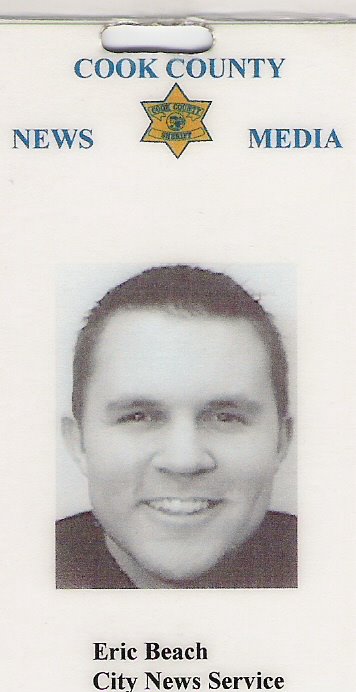
Due to a sprained ankle suffered while chasing down and apprehending some young punk who stole tips from the coffee-chain-that-shall-remain-nameless, The Beach Picayune was unable to be published for the last month. The editorial board regrets this lapse in coverage but pledges to return the thankless work of publishing the Picayune.
The Editorial Board of the Beach Picayune
Monday, December 12, 2005

Sunday, November 06, 2005
Afraid of the Dark Pt.1
(This may seem like it was written in fast forward mode.)
I was scrubbing my dirty bathtub with Clorox bleach cleaner on Saturday. I had a good start to my day with two cups of Arabian Mocha Sanani and my compartmentalized time with God.
I had a rock station playing while I scrubbed. A dark, pulsating industrial tune began playing and I recognized it as "No. 1 Fan" by Garbage. " I would die for you...I would cry for you...I would crawl on hands and feet until I bleed." The words were acidic, gothic and disturbing but the music was entrancing.
I remembered then how much I like darker music like Garbage, Linkin Park or any other secular band that honestly devles into the darkness of this life. I can't get enough of this darker music. I confess that most of my regular digest of music now is not produced by someone who follows Christ. And I'm okay with that.
Naturally, there are dangers to such a diet at this. The constant hopeless messages or depressing conclusions could easily begin to convert one's ways of thinking. A friend of mine realized this and is fasting from secular music for his health (see Trent's blog on the list of links further down the page).
But there is a tendency in Christian music to be afraid of the dark. Afraid of those honest but dangerous expeditions into the treacherous land of human emotion and experience. Sadly, there are followers of Christ who have adopted the ancient idea that the spiritual life should be more important the physical or human life. The messy, the torturous , the mindfield that is our God-given emotions are ignored or suppressed with zeal. And much to the detriment of a person's entire being.
I know this lifestyle all too well, having zealously pursued it for a period of time. But thankfully, I matured in my understanding of theology, humanity and where and how those two things intersect. I am thankful for a high school english teacher, with his long hippie hair and his own rock band, for getting me hooked onto Led Zeppelin. I am thankful for those trepidations first steps of buying a Moby CD and a Radiohead album. I am thankful for the realization that my human emotions need to be included in my spiritual life and should be explored in order to benefit my spiritual maturity.
And not all of my bridges from the world of Christian music have been burned; only about 81% percent of them. Those 81% were bridges that led me away from music that simplified too much; that formulaized too much; that was too afraid to venture out into the unknown territory of emotions. The remaining passages still receive traffic when a band can creatively or honestly sing of the spiritual life and man's eternal crusade to be redeemed.
Christian music that isn't afraid of the dark sits right beside other musicians, like Ben Folds or Ray Lamontagne, who aren't either.
Monday, October 24, 2005
Angst-Fueled Thoughts Lead to Spiritual Revelation
So it was 11:30 p.m. on some weeknight and I was restless. I had an aching to be out doing something late at night again. Being a reporter during the graveyard shift had left me with the need to be up when only a small percentage of the population still is. To be out and conscious while the rest of the city sleeps.
I realized that this sort of restlessness, this angst, is the perfect subject for a blog. It would be a great intro to catch a reader's attention. It's a vague feeling that surely someone else has had and can relate to but, like me, is not quite sure how to put it into words.
So I ask a friend if she knows a coffeehouse that's open all night besides the well-known anchor of Old Town at Piper's Alley, the collossus of coffee, the ever-present espresso pedler, the coffee-chain-that-shall-remain-nameless. This fell0w night-dweller knew of a place: the Pick Me Up Cafe on Clark. I drove there only to discover a line of people waiting to be seated in the not-so-reflection-inducing, sit-down restaraunt atmosphere. I felt a little out of place walking in with a black leather journal, a legal notepad for blog ideas and The Shipping News, by E. Annie Proulx; the materials necessary for reflection and digestion.
This is a good illustration of angst-driven restlessness, that need for reflection and connection with God. People can relate to this common experience.
So I settled on the haven that vampires, homeless men, chess players and procrastinating students can all agree on: the coffee-chain-that-shall-remain. I drove another few miles and parked up the street, only to find that on this night, it was closed. Apparently, a power-washing crew was super-scrubbing the floors to remove the grime that builds up on a continual basis on the floor.
This was a realistic portrayal of a struggle or a Pilgrim's Progress-like journey that readers can be drawn in to. Will the faithful (but Angst-filled) Christian find that much-needed time of reflection and contemplation? Will he be able to not settle for that coffee-chain-that-shall? Will there be some resolution or spiritual revelation?
I was out of options and I've already driven all around town. I gave up and headed back to my apartment. A Burger King with an open-late drive thru got my business that night. I ate my pre-fab Hershey's Pie on my back porch that night and just enjoyed the night sky.
And then I realized that I could have some spiritual revelation on my back porch. I could come to the conclusion that the only place to sooth my restlessness was in fellowship with Christ. Or I could remember that I didn't need a pre-fab atmosphere, or as some would call it the "Third Place," in order to sort through thoughts and see how my faith fits into my present life.
And soon enough, I'll have written enought to satisfy my readers with more angst-fueled thoughts that lead to a spiritual revelation.
Friday, October 14, 2005
Donnie Darko enthusiastts-Start drooling
I've done some research on a very well-made but confusing movie. Here's a buddy of Eberts' take on it and a writer from Christianity Today's Books and Culture Magazine.
http://us.f1.yahoofs.com/bc/3f838842_1414c/bc/essays/Donnie+Darko+essay.doc?bf71AUDBC1Y83Ghx
http://us.f1.yahoofs.com/bc/3f838842_1414c/bc/essays/DonnieandtheBunnyman[2].doc?bf71AUDBd5ItWXhn
These are great if you're a fan or wanting to just figure out what the movie was about.
http://us.f1.yahoofs.com/bc/3f838842_1414c/bc/essays/Donnie+Darko+essay.doc?bf71AUDBC1Y83Ghx
http://us.f1.yahoofs.com/bc/3f838842_1414c/bc/essays/DonnieandtheBunnyman[2].doc?bf71AUDBd5ItWXhn
These are great if you're a fan or wanting to just figure out what the movie was about.
Thursday, September 29, 2005
Wisdom from the Past
I've been re-reading a journal I've kept that's covered the last two and half years of my life. I've found some pretty strong stuff that's encouraging and challenging.
It seems it's always good to remember the past, for all it's struggles and joys, because the past defines who you are and how you handle the present. On a less philosophical note, you can also learn from your mistakes and, hopefully, not make them again.
Here's some excerpts:
"A friend's words came back to me (concerning worship): Even if your not truly in it, you're speaking words of truth (and that means something). 'Half of everyone else in the room probably didn't do their devos this morning either.'
"The idea of God using us in spite of ourselves seems to connect here. Like the whiskey priest in Greene's The Power and The Glory. He was drunk half of his life and he still had to be a priest to so many people. He had to give last rites, communion and hear confessions and baptize hundreds while he himself was far from being right with God. He was distrusting of the guy with the two yellow teeth (instead of loving); he was a coward when it came to his duty (instead of bravely performing his duty); he merely went through the motions of doing mass for a few small villagers (instead of faithfully putting all the meaning into the acts and truly talking to God).
"Even me writing this page and a half on the subject could be evidence. I'm writing up a storm on my 'bad day'. But, as I remember more, I always write more and can think with more clarity when things are wrong. But I have to write everyday, whether or not I think I have time. Writing is just as important as reading my Bible or praying..."
....
"And last night I talked to (a guy who had left stuff on my floor at school). Another friend had given me the idea and all I thought to ask about was his stuff. But when he answered, he seemed so relieved and encouraged. He even went through the 'I was gonna call you' routine. He told me about his year and how it was rough but refining. I felt bad for calling him about when he was going to pick up his stuff. But he was still encouraged and flattered that I called him. Call me the whiskey priest again."
Wednesday, September 14, 2005
A King's Religion
Wes Craven grew up in a fundamentalist Baptist home. Stephen King grew up in the Methodist church. Who woulda’ thunk it?
Although I’ve yet to see some ripples of that upbringing in Red Eye, Scream or Nightmare on Elm Street, I have seen them in a novel by King and in his memoir On Writing.
It made me seriously consider where King’s life may lay; but only for an hour or so. I finished Desperation and then realized my delusions of spiritual grandeur. King may be been brought up in the as a Methodist but the ripples of his rearing didn’t flow into what I wanted to see in his novel.
Like countless other believers, I wanted to see some sense of spiritual truth in some celebrity to make my faith seem more real, more authentic. As if some celebrity could truly authentic anything except the shallow vacuousness of celebrity. But I read between the lines to find it anyway.
Probably not since The Stand has King written something so overtly religious as Desperation. The premise is easy: a cast of random characters is imprisoned by a devilishly supernatural cop in a small mining town where something sinister was dug up in the mines.
The leader of the survivors is a pre-adolescent boy named David Carver, who, a year or two earlier, had a conversion experience where his prayer of faith miraculously healed a friend who was deathly ill. David had then had regular meetings with a priest to dialogue about faith. That faith is what makes for some dramatic, although sometimes silly scenes in the book.
All of the survivors were locked away in prison cells when David had a vision, or heard a voice direct him to a bar of Irish Spring soap in his cell. So he stripped down, soaped up and began to slip through the steel bars. And somehow, miraculously, his head was able to squeeze through as well. He said later that God directed him to the soap which enabled to escape the prison and find keys to free everyone else.
The oddest scene was in an abandoned theatre where all the survivors had holed up to escape the cop. People were looking for food and found a sleeve of Ritz crackers and a couple of cans of sardines. Before devouring the only food everyone had had in over twelve hours, David thought of asking the blessing on the food. After quelling objections from some of the people, David prayed and asked a blessing. Then one person began passing around the bag. Somehow, everyone was able to take from the sleeve of Ritz and all received a can of sardines. Somehow, the brown paper bag never ran out of sardines and crackers.
I didn’t know whether to laugh or get upset at that. Or if I should really do either.
So there were some other religious imagery scattered throughout the novel but they all seemed to be disconnected and disjointed. They didn’t flow together in some bigger picture or prove to work together to make some kind of religious point. They were merely plot devices without any meaning.
This can only be expected considering how King writes. He prefers to not plot out his stories but only try to develop his characters. This isn’t a horrible way to write but then the story can almost seem aimless.
In spite of the aimless imagery, King did have a little redeeming theology that was worked into the story. David Carver and another of the survivors, a cocky writer surely to be modeled after part of King’s own personality, came to the conclusion that God can be cruel but refining. This was the one redeeming facet to the seven hundred pages of horrific and Texas Chainsaw Massacre-like gore.
Another revealing passage on King’s religious beliefs came in the middle of On Writing. King was hired to move some furniture to make ends meet during his early writing career. He was in the trailer home of the mom of a girl that gave King the idea for writing Carrie. Inside the trailer was an ugly crucifix:
“Dominating the trailer’s living room was a nearly life-sized crucified Jesus, eyes turned up, mouth turned down, blood dribbling from beneath the crown of thorns on his head. He was naked except for a rag twisted around his hips and loins. Above this bit of breechclout were the hollowed belly and the jutting ribs of a concentration-camp inmate. It occurred to me that Sondra (the girl who inspired Carrie) had grown up beneath the agonal gaze of this dying god, and doing so had undoubtedly played a part in making her what she was when I knew her: a timid and homely outcast who went scuttling through the halls of Lisbon High like frightened mouse.
‘That’s Jesus Christ, my Lord and Savior,’ Sondra’s mother said, following my gaze. ‘Have you been saved, Steve?’
I hastened to tell her I was saved as saved could be, although I didn’t think you could ever be good enough to have that version of Jesus intervene on your behalf. The pain had driven him out of is mind. You could see it in his face. If that guy came back, he probably wouldn’t be in a saving mood.”
Monday, September 05, 2005
Prayers...
Here's a couple prayers I put together for a congregational prayer section of my church's service. It was great to be able to write it out and organize it all.
May 2005
The Lord will roar from on high and from his holy habitation utter his voice; he will roar mightily against his fold and shout against all the inhabitants of the earth. The clamor will resound to the ends of the earth, for the Lord has an indictment against the nations, he is entering into judgment with all flesh, and the wicked he will put to the sword.
O, Lord, how mighty is your power and your wrath for none can stand against your holiness. Yet in your complexity, you are everlastingly love.
The Lord is slow to anger and abounding in steadfast love, forgiving iniquity and transgression. He will pardon the iniquity of his people, according to the greatness of his steadfast love, just as he has forgiven his people, from Egypt until now.
Your love draws even the most unloveables to You. You pardon our sins without keeping record. Your complexity knows no bounds and we are blessed to understand what little our finite minds can grasp. The only way to comprehend what we can of You is to hold all your abilities and characteristics in tension through the wisdom from your Spirit. It is through that tension that we can fathom our lostness and your grace; our being redeemed but not yet complete; your coming to earth in our decayable flesh and your perfect, final return. It is in your complexity that we can understand how you cursed a fruitless fig tree that withered away to its roots yet fully restored the withered hand of a shamed man at the synagogue. Your fury, love, wrath and grace are wonderful things.
We ask for a glimpse of your greater plan of redemption so we can know how to better serve you in our short time on earth. Help us to see the people you’ve placed in our lives that need to hear Your truth and give us courage to speak that truth.
And lastly, blanket us with your wisdom so we can continue to understand all your complexities and how they all fit together in a giant plan that we will probably never be able to view as a whole in this life.
Aug. 2005
It seems that we are always the prodigal son returning to our loving father with our heads held low in shame. For we know how righteous and holy You are and how much an affront our sin is to you. It seems like just yesterday we had squandered the grace and mercy you cloaked us with when we returned the last time and are again in need of redemption.
But what this repetition has made us forget is that your forgiveness and love are the same as the last time we came trudging home. Your unceasing, unconditional love is there, waiting to rejoice at the sight of us confessing our sins and admitting that we can’t save ourselves. You are eagerly awaiting the moment when you can kill the fatted calf in celebration of our returning to you. You never grow tired of forgiving us and giving more grace for us to be the holy people we ought to be.
Thank you for the joy and hope we have in being loved by you. It is so easy to be overwhelmed by the guilt of our sins that we forget the true nature of your love. We forget that your grace exists to help us to be more than human and to exhibit your holiness. We forget that the joy and peace with our sometimes turbulent lives is what can attract other to you. The true happiness in spite of our humanness is what calls people to find where our hope comes from.
We ask that we understand and remember the joy that comes from being forgiven and are able to exhibit that joy to all those you bring into our lives.
Sunday, July 31, 2005
Between a rock and loving place
I've found myself hanging out a lot with the comrades from the coffee-chain that shall remain nameless. I almost preferred their company to that of my local rock, my body of Christ one weekend.
I know what should be my base, fuel and reason for existing. And I know what acceptance and friendship are. And I know the bonds that are forged through the fires of trial, the pains of incompetant co-workers, and the shared sufferings of peddling the world's most expensive coffee.
It's seeming that in order to truly be Christ to them, I've got to be a friend to them. The picture's a little fuzzy right now but I seem to have glasses on that are helping me to be far-sighted and know what I'm being a friend for (besides just being a friend for friend's sake).
Thursday, July 21, 2005
Traffic in Humboldt
I heard the sing-song happy music broadcast out of a scratchy speaker outside my apartment and knew that my local ice cream truck was driving down my block. I grabbed a handful of change from my change mug and dashed outside to catch the truck that would happily coat my mouth with lactose-based soft serve.
Luckily, a hispanic kid had flagged it down and was getting a banana boat ice cream cone. I asked for a Boston Shake when it was my turn. As I waited for it to be made, I had to breathe in the exhaust fumes that sputtered out of the truck. "I bet if you stand here long enough, you could get high," I wondered.
But then I also remembered having a conversation with someone about another way to get high from the neighborhood ice cream truck. It began with the observation that the truck had been out one night around 1:30 a.m. Now I know that only naughty children are out that late but I'm sure that those same naughty children may be able to get some naughty treats from the possibly naughty ice cream truck. And none of those treats would be lactose-based.
If the truck is as naughty as it seems, then it is only one of many ways to traffic naughty treats in my neighborhood. Through careful observation ( not even as a reporter but as a person who spends hours sitting on his apartment's front steps in order to get clear phone reception), I've come to realize that all I'd have to do to get high would be to talk my neighbors.
I can ride up on a bike and nod to the right person and he would leave his place of holding up the steel gates by the sidewalk and exchange whatever I'd like. Since I don't have a bike, I could drive up to another section of my block, say 'Hey' and another guy would hop into my car while I drove around a couple blocks and made a transaction in the privacy of my car.
If it were a few months ago, I could have just walked around near my place and looked for small dime bags stashed out in the open so no one person would be caught with them. They would be lodged between the post and wire mesh of a fence on the sidewalk, hidden in a hole between the edge of a sidewalk and the ground (where hopefully the rats wouldn't find them) or even in the cylindrical cones used to prevent people from reaching around to the nob on the inside of a steel gate. The tactical officers from the Shakespeare District station somehow caught on and searched my street for all the little nooks and crannys that hid the naughty treats.
I pondered all this as I sipped my shake and realized that I'd soon be saying goodbye to this neighborhood. I began to feel an odd sensation in my head after downing half of the Boston Shake. I probably wouldn't be able to run after the ice cream truck in my new neighborhood of Lincoln Square. And if I did, I'm sure they wouldn't serve the same tasty treats as my current neighborhood. My motor synapses seemed to be slow in functioning and I felt like I was wearing someone else's heavy perscription glasses. Everything began to be funny, even Saturday Night Live. There would be no more late night fixes from the ice cream truck...or was it a whale? I know it was big and blue and had eyes painted on the side. I wonder if the truck could fly like the Magic School Bus and play "What a Long, Strange Trip It's Been" by the Grateful Dead.
I'm sure gonna miss those Bostson Shakes.
Friday, July 15, 2005
Friday, June 24, 2005
The Coffee Master
Due to recent circumstances at my local coffee-chain-that-shall-remain-nameless, I have stepped up to the plate to become the barista that can. The master barista that glides around the espresso station in an effortless flow of arms, milk, espresso and plastic lids. If you slow down the security tapes to half-speed, you can almost see my arms pump four squirts of mocha into the medium cup while simultaneously marking the cup with a script only decipherable to the most-trained super-barista.
Our manager has up and moved to NYC where people apparently are more willing to pay bigger bucks for his artwork. Another senior barista (who preceded me by only a few weeks) who would have taken the spot had to move back to Oregon for surgery on a cist near his spine. The 50-some-year-old employee who is a 7-year veteran of the company, was forever banned from the barista station for slapping the hand of a customer who reached into the station to get something.
So who is left? The guy hired nearly two months ago that is to be the center of the all that is the coffee-chain-that-shall-remain in our River North neighborhood. After a few days on stepping into the fray of employees at registers calling out drinks and customers gathering around like zombies waiting for another taste of blood, I am the sole Barista.
It is I who must use his innate attention to detail to magically make an iced, decaf, triple tall, sugar-free vanilla, two percent, extra hot latte appear out of thin air from behind the mechanized monster call the espresso machine. It is I who must battle the monster with my keen hearing and mutli-tasking ability to catch the scalding hot shots in labeled cups with syrup and other extras (even a freakin' packet of Sweet and Low) while finishing them off with the correct lid and cardboard sleeve (correctly labeled with the dreaded company logo). All the while never running out of steamed non-fat (not skim because skim could be confused with soy) or whole milk and never having the machine stop to have you empty out the spend espresso pucks, refill the espresso bean hoppers and never missing the next three drinks being called out by the company "partners" (as all employees are called in this communistic company).
And if by chance, I shall one day defeat this mighty monster, I can one day be called a shift supervisor (or if I can learn to swallow enough corporate BS) even Coffee Master (which is the communist term for asst. manager).
Thursday, June 09, 2005
Top __ Reasons you shouldn't have signed the lease on your apartment
10. A bald musician named Frank lives in your basement with a ten-piece drum set.
9. You have to go to that a neighborhood fruit stand to drop off your rent money.
8. Your landlord tells you that if he didn't like you, he'd have charged you three hundred dollars more for the place.
7. You realize your garden apartment actually was used as an interrogation room for the mob but the landlord added another window and a bathroom since those days.
6. The two squad cars and police sergeant who greeted you at your first viewing of the place now know you by name.
And I'm out of funny reasons so five is all you'll get.
Wednesday, June 01, 2005

Moody Over Margaritas
"How many people have to kill themselves before Moody does something?"
A friend of mine posed this question not too long ago while she and another friend of mine joined me at an outdoor patio of a restaurant.
It was the first sunny day that dried up the April showers and began to usher in the May flowers. The breeze bustled through the patio and made me wonder how heavy the margarita glasses on our table were. They were holding their own so they must be heavy enough.
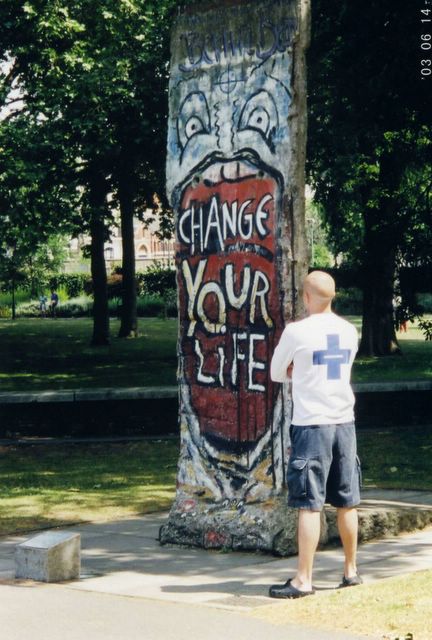
Each of us were halfway through our tequila and lime drinks when my friend (whom I hadn't talked with in over a year) asked, "Did you know Clark Stacy?" (See $%&*& $*#!)
It seemed that she had traveled to Europe one summer with a school trip. She got to know Clark well and took the above photograph while traveling over there.
All three of us knew Clark and all three of us knew depression. We vented about all our frustrations and then came the million dollar question I began with.
Is that too harsh? Too over-dramatic? Some could not even conceive of an institute that trains the next generation of Christian leaders as being responsible for the suicide of one of it's trainees. Yet some would cast the blame no where else.
We dialogued about frustrations over the loss of Clark, the culture of evangelicalism and our alma mater. It was an odd sort of therapy session that lasted for almost two hours. Even as the sun disappeared behind some buildings and the breeze brought back the all too familiar chill, we kept talking and chomping down on the guacamole and chips we ordered. All the other customers had retreated into the restaurant to warm up.
The chill outside reminded us that it was not yet the longed-for summer. We were inbetween seasons, having lived through the sunless winter and rainy spring but still waiting for the deliverance of summer. We were in an inbetween period where we had to persevere for the better that was to come.
My friend only lived about a block from the restaurant and invited us over to see her place. She mentioned earlier that a friend had given her an expensive bottle of tequila as a gift and that she didn't want to just open it to drink it alone. This seemed like a worthy occasion so she opened it.
"So what are we going to drink to?" she asked. "You're supposed to drink to something."
"How 'bout surviving?" I said.
"That sounds good," said my other friend.
"To surviving evangelicalism," she said.
We raised our shot glasses with a clink and let the warmth of the liquor remind of the coming summer.
Tuesday, May 24, 2005
Black, White and Red (Sometimes) All Over
During my many hours of TV watching last week, I came a across a show that I swore would have been directed by Quentin Tarantino (Kill Bill Vol.s, Pulp Fiction and the like). And sure enough, as I read in the entertainment section of the newspaper, it was.
What gave it away were scenes ripe with pop culture references, an imaginative presentation of gore (the show was CSI) and his trademark new style: using black and white film in particularly violent scenes.
The two-hour season finale of CSI saw one of the main characters getting buried alive in a glass coffin, much like Uma Thurman in the second Kill Bill. The rest of the team spent the remaining time trying to find him and dig him out without setting off the explosive charges rigged to the coffin. This is trademark Tarantino 'creativity.'
During the show, the man who buried the c.s.i. blew himself up in an attempt to take out other c.s.i. When the explosion was shown, the film switched to black and white to show the results. The film switched back to color to show that another c.s.i. had survived the blast.
Still later in the show, the man buried alive had either a dream or hallucination that an autopsy was being performed on him while he was conscious. When the blood began to flow and the organs were passed around, the film was in black and white again. After it was over, the man dreaming was shown from the neck up in color, slighty bloody (althouth not flowing). To end the scene, the doctors jokingly picked up the man's heart and told the subject's father, "He had a good heart." You gotta love that creativity and wit.
Tarantino used the same method in the Kill Bill Vol. 1 in order to not disturb a 10-15 minute scene where Uma Thurman slaughters an 88-man Japanese hit squad in some pretty disturbing ways. The color instantly disappeared when Thurman took out an eye of one of the men, making it an interesting style and transition to black and white. It returned to normal when Thurman blinked her eyes in a facial close-up after most of the team lay throughout the scene in varying degrees of slaughter.
Tarantino and Robert Roderiguez used similar techinques in Sin City (See Love, BaSin City Style). Most of the movie was already in black and white to begin with but when even the brutality was too much for black and white, the film took another step. Black and white cut-outs of characters were used to portray what happened, almost like flannelgraph figures on a felt board. This was used to show Elijah Wood's character get eaten by a dog.
Somehow, the color swap makes the violence not as visceral or real. And that's why the MPAA says okay to an R-rating for the above mentioned films. Kudos to Tarantino on the creative use of style to make us almost enjoy watching violence.
But woe to us if we are enticed to sit through this style in a movie which lacks any redeeming qualities.
Wednesday, May 11, 2005
Palahniuk Inspires
“Maybe people have to suffer before they can risk doing what they love.”
You told Misty all this.
You said how Michelangelo was a manic-depressive who portrayed himself as a flayed martyr in his painting. Henri Matisse gave up being a lawyer because of appendicitis. Robert Shumann only began composing after his right hand became paralyzed and ended his career as a concert pianist.
…
You talked about Nietzsche and his tertiary syphilis. Mozart and his uremia. Paul Klee and the scleroderma that shrank his joints and muscles to death. Frida Kahlo and the spine bifida that covered her legs with bleeding sores. Lord Byron and his clubfoot. The Bronte sisters and their tuberculosis. Mark Rothko and his suicide. Flannery O’Connor and her lupus. Inspiration needs disease, injury, madness.
“According to Thomas Mann,” Peter said, “‘Great artists are great invalids.’”
The above is an excerpt from Diary, a novel by Chuck Palahniuk, who also wrote Fight Club. So far (78 pages into it) I’m hooked and (despite the cliché-ness of it) inspired by it. The above talk about artists and the writing style of the book itself is inspiring.
The nihilistic tone made famous by the rants of Tyler Durden is the basis for the book; yet in the blunt, crassness of the writing all that is faux is stripped away, leaving raw nerves, harsh realities. But those nerves and realities are what lead to authentic change.
In the book, an artist named Misty married young in art school and was swept away to some idyllic small town on an idyllic island home where she could paint pictures that would change people’s lives. But the island was spoiled by tourists, advertisements and commercialism, and her husband, Peter, shot himself in the family car.
While the husband sits in a hospital hooked up to life support, Misty gets calls from summer home owners in the idyllic towns near the island where Peter had done some remodeling during the winter. Everyone complains of kitchens or linen closets missing from their homes, leading Misty to find that Peter sealed in entire rooms from the house.
Inside the rooms are nonsensical, yet prophetic scrawlings covering the sealed-in rooms. Some of it is nonsense while others are crass descriptions of life on the island. Intermingled with the nonsense are random quotes from various artists that somehow apply to life on the island or Misty.
I don’t know what happens from then on as Misty tries to figure out what all that means but I know that Palahniuk is an engaging storyteller. And the artistic dialogue is spurring me on to produce something.
From Homicide to Espresso
Change is good. Especially when you're able to change the types of conversations you have during the normal course of the day.
I used to have to ask, "Well, how many times was the man shot and where? Were there any shell casings at the scene? Was the shooting gang-related? Are you currently questioning the mother in connection to the shooting?"
But now I'll have to ask, "Would you like that frappacino affogato style? Would you like to try our new Chantico drinking chocolate? How's it going, do you want your normal double-shot soy latte? You're asking me if refills are free?"
I have succumbed to working for the man, the Big Brother of coffee, the corporate, suburbanized chain store I have always tried to avoid if possible. But to avoid advertising for them, I shall call them the coffee-chain-that-shall-remain-nameless.
Call me a sell-out but the benefits, flexibility and quality tips seemed a good offer at the coffee-chain-that-shall-remain. This would be career suicide if I were to pursue journalism but since I'm not, the coffee-chain-that-shall will work fine.
It's kind of a career twist but who doesn't need a change now and then to refocus their lives, reevaluate career choices and rediscover what a person's passions are. And the coffee-chain-that-shall seems to be an ideal place for that.
And if you know me, that means that sometime in the near future, you'll be getting a pound of beans from the the coffee-chain-that.
Monday, April 18, 2005
Fun At The Library
I visited my local public library today and found out just how comfortable some people are looking at porn.
I was in a computer room, when I happened to look behind me and saw a man on the opposite wall, looking at all kinds of porn. There were about seven other people in the room, including teenage girls.
Now each computer had a screen draped in front of the monitor that made viewing from anywhere but directly in front of it difficult. So people couldn't directly see what he was looking at except if they were in front of the monitor, or across the room and directly behind it, as I was.
A librarian even came into the room to help someone beside the man print something. Before this, the young girl beside the man asked him if he knew how to print something from the computer. He calmly told her how and went back to his voyeristic viewing in the middle of the afternoon in the library.
I never thought someone would be bold enough or desperate enough to have to go to a library to look at porn. But, then again, maybe I overestimated everyone's carnal nature.
Too bad libraries have become battle grounds for freedom of expression and ways for the ACLU to fight for the ability to look at pornography next to teenage girls.
Monday, April 11, 2005
Love, BaSin City Style
After slightly recovering for a few days after viewing the life and times of criminals and prostitutes from Basin City at my local movie theater, I can almost find some redeemable quality to it(besides the style and panache of director Robert Roderiguez).
One story line has a guy named Marv (Mickey Rourke with lots of prostheses) somehow being redeemed by a night with a lady of the night named Goldie. While they're both sleeping, a cannibalistic Frodo kills Goldie mysteriously, leaving Marv to deal with cops who think he killed her.
So anyway, Marv evades the cops and then tracks the spectacled Elijah Wood down by questioning other people and killing them in grand, bloody, Flannery O'Conner-like ways. He then finds Kevin (Elijah Wood) and lets the culprit experience a different form of cannibalism to complete the cycle of revenge.
So somewhere in there is something redeemable? Sort of. Marv seemed to have felt redeemed by that night with Goldie. His criminal past and violence were assuaged and his soul was somehow redeemed, or so he tells the audience. He valued that love so much he was willing to kill again and again and again. And then again and again and yet again.
So love is the highest cause or worth fighting for? Or love is what can redeem us? I don't know. That little bit seemed to be something to help me justify seeing one of the nastiest movies yet to date.
Subscribe to:
Posts (Atom)