I've found myself hanging out a lot with the comrades from the coffee-chain that shall remain nameless. I almost preferred their company to that of my local rock, my body of Christ one weekend.
I know what should be my base, fuel and reason for existing. And I know what acceptance and friendship are. And I know the bonds that are forged through the fires of trial, the pains of incompetant co-workers, and the shared sufferings of peddling the world's most expensive coffee.
It's seeming that in order to truly be Christ to them, I've got to be a friend to them. The picture's a little fuzzy right now but I seem to have glasses on that are helping me to be far-sighted and know what I'm being a friend for (besides just being a friend for friend's sake).
Sunday, July 31, 2005

Thursday, July 21, 2005
Traffic in Humboldt
I heard the sing-song happy music broadcast out of a scratchy speaker outside my apartment and knew that my local ice cream truck was driving down my block. I grabbed a handful of change from my change mug and dashed outside to catch the truck that would happily coat my mouth with lactose-based soft serve.
Luckily, a hispanic kid had flagged it down and was getting a banana boat ice cream cone. I asked for a Boston Shake when it was my turn. As I waited for it to be made, I had to breathe in the exhaust fumes that sputtered out of the truck. "I bet if you stand here long enough, you could get high," I wondered.
But then I also remembered having a conversation with someone about another way to get high from the neighborhood ice cream truck. It began with the observation that the truck had been out one night around 1:30 a.m. Now I know that only naughty children are out that late but I'm sure that those same naughty children may be able to get some naughty treats from the possibly naughty ice cream truck. And none of those treats would be lactose-based.
If the truck is as naughty as it seems, then it is only one of many ways to traffic naughty treats in my neighborhood. Through careful observation ( not even as a reporter but as a person who spends hours sitting on his apartment's front steps in order to get clear phone reception), I've come to realize that all I'd have to do to get high would be to talk my neighbors.
I can ride up on a bike and nod to the right person and he would leave his place of holding up the steel gates by the sidewalk and exchange whatever I'd like. Since I don't have a bike, I could drive up to another section of my block, say 'Hey' and another guy would hop into my car while I drove around a couple blocks and made a transaction in the privacy of my car.
If it were a few months ago, I could have just walked around near my place and looked for small dime bags stashed out in the open so no one person would be caught with them. They would be lodged between the post and wire mesh of a fence on the sidewalk, hidden in a hole between the edge of a sidewalk and the ground (where hopefully the rats wouldn't find them) or even in the cylindrical cones used to prevent people from reaching around to the nob on the inside of a steel gate. The tactical officers from the Shakespeare District station somehow caught on and searched my street for all the little nooks and crannys that hid the naughty treats.
I pondered all this as I sipped my shake and realized that I'd soon be saying goodbye to this neighborhood. I began to feel an odd sensation in my head after downing half of the Boston Shake. I probably wouldn't be able to run after the ice cream truck in my new neighborhood of Lincoln Square. And if I did, I'm sure they wouldn't serve the same tasty treats as my current neighborhood. My motor synapses seemed to be slow in functioning and I felt like I was wearing someone else's heavy perscription glasses. Everything began to be funny, even Saturday Night Live. There would be no more late night fixes from the ice cream truck...or was it a whale? I know it was big and blue and had eyes painted on the side. I wonder if the truck could fly like the Magic School Bus and play "What a Long, Strange Trip It's Been" by the Grateful Dead.
I'm sure gonna miss those Bostson Shakes.
Luckily, a hispanic kid had flagged it down and was getting a banana boat ice cream cone. I asked for a Boston Shake when it was my turn. As I waited for it to be made, I had to breathe in the exhaust fumes that sputtered out of the truck. "I bet if you stand here long enough, you could get high," I wondered.
But then I also remembered having a conversation with someone about another way to get high from the neighborhood ice cream truck. It began with the observation that the truck had been out one night around 1:30 a.m. Now I know that only naughty children are out that late but I'm sure that those same naughty children may be able to get some naughty treats from the possibly naughty ice cream truck. And none of those treats would be lactose-based.
If the truck is as naughty as it seems, then it is only one of many ways to traffic naughty treats in my neighborhood. Through careful observation ( not even as a reporter but as a person who spends hours sitting on his apartment's front steps in order to get clear phone reception), I've come to realize that all I'd have to do to get high would be to talk my neighbors.
I can ride up on a bike and nod to the right person and he would leave his place of holding up the steel gates by the sidewalk and exchange whatever I'd like. Since I don't have a bike, I could drive up to another section of my block, say 'Hey' and another guy would hop into my car while I drove around a couple blocks and made a transaction in the privacy of my car.
If it were a few months ago, I could have just walked around near my place and looked for small dime bags stashed out in the open so no one person would be caught with them. They would be lodged between the post and wire mesh of a fence on the sidewalk, hidden in a hole between the edge of a sidewalk and the ground (where hopefully the rats wouldn't find them) or even in the cylindrical cones used to prevent people from reaching around to the nob on the inside of a steel gate. The tactical officers from the Shakespeare District station somehow caught on and searched my street for all the little nooks and crannys that hid the naughty treats.
I pondered all this as I sipped my shake and realized that I'd soon be saying goodbye to this neighborhood. I began to feel an odd sensation in my head after downing half of the Boston Shake. I probably wouldn't be able to run after the ice cream truck in my new neighborhood of Lincoln Square. And if I did, I'm sure they wouldn't serve the same tasty treats as my current neighborhood. My motor synapses seemed to be slow in functioning and I felt like I was wearing someone else's heavy perscription glasses. Everything began to be funny, even Saturday Night Live. There would be no more late night fixes from the ice cream truck...or was it a whale? I know it was big and blue and had eyes painted on the side. I wonder if the truck could fly like the Magic School Bus and play "What a Long, Strange Trip It's Been" by the Grateful Dead.
I'm sure gonna miss those Bostson Shakes.
Friday, July 15, 2005
Friday, June 24, 2005
The Coffee Master
Due to recent circumstances at my local coffee-chain-that-shall-remain-nameless, I have stepped up to the plate to become the barista that can. The master barista that glides around the espresso station in an effortless flow of arms, milk, espresso and plastic lids. If you slow down the security tapes to half-speed, you can almost see my arms pump four squirts of mocha into the medium cup while simultaneously marking the cup with a script only decipherable to the most-trained super-barista.
Our manager has up and moved to NYC where people apparently are more willing to pay bigger bucks for his artwork. Another senior barista (who preceded me by only a few weeks) who would have taken the spot had to move back to Oregon for surgery on a cist near his spine. The 50-some-year-old employee who is a 7-year veteran of the company, was forever banned from the barista station for slapping the hand of a customer who reached into the station to get something.
So who is left? The guy hired nearly two months ago that is to be the center of the all that is the coffee-chain-that-shall-remain in our River North neighborhood. After a few days on stepping into the fray of employees at registers calling out drinks and customers gathering around like zombies waiting for another taste of blood, I am the sole Barista.
It is I who must use his innate attention to detail to magically make an iced, decaf, triple tall, sugar-free vanilla, two percent, extra hot latte appear out of thin air from behind the mechanized monster call the espresso machine. It is I who must battle the monster with my keen hearing and mutli-tasking ability to catch the scalding hot shots in labeled cups with syrup and other extras (even a freakin' packet of Sweet and Low) while finishing them off with the correct lid and cardboard sleeve (correctly labeled with the dreaded company logo). All the while never running out of steamed non-fat (not skim because skim could be confused with soy) or whole milk and never having the machine stop to have you empty out the spend espresso pucks, refill the espresso bean hoppers and never missing the next three drinks being called out by the company "partners" (as all employees are called in this communistic company).
And if by chance, I shall one day defeat this mighty monster, I can one day be called a shift supervisor (or if I can learn to swallow enough corporate BS) even Coffee Master (which is the communist term for asst. manager).
Our manager has up and moved to NYC where people apparently are more willing to pay bigger bucks for his artwork. Another senior barista (who preceded me by only a few weeks) who would have taken the spot had to move back to Oregon for surgery on a cist near his spine. The 50-some-year-old employee who is a 7-year veteran of the company, was forever banned from the barista station for slapping the hand of a customer who reached into the station to get something.
So who is left? The guy hired nearly two months ago that is to be the center of the all that is the coffee-chain-that-shall-remain in our River North neighborhood. After a few days on stepping into the fray of employees at registers calling out drinks and customers gathering around like zombies waiting for another taste of blood, I am the sole Barista.
It is I who must use his innate attention to detail to magically make an iced, decaf, triple tall, sugar-free vanilla, two percent, extra hot latte appear out of thin air from behind the mechanized monster call the espresso machine. It is I who must battle the monster with my keen hearing and mutli-tasking ability to catch the scalding hot shots in labeled cups with syrup and other extras (even a freakin' packet of Sweet and Low) while finishing them off with the correct lid and cardboard sleeve (correctly labeled with the dreaded company logo). All the while never running out of steamed non-fat (not skim because skim could be confused with soy) or whole milk and never having the machine stop to have you empty out the spend espresso pucks, refill the espresso bean hoppers and never missing the next three drinks being called out by the company "partners" (as all employees are called in this communistic company).
And if by chance, I shall one day defeat this mighty monster, I can one day be called a shift supervisor (or if I can learn to swallow enough corporate BS) even Coffee Master (which is the communist term for asst. manager).
Thursday, June 09, 2005
Top __ Reasons you shouldn't have signed the lease on your apartment
10. A bald musician named Frank lives in your basement with a ten-piece drum set.
9. You have to go to that a neighborhood fruit stand to drop off your rent money.
8. Your landlord tells you that if he didn't like you, he'd have charged you three hundred dollars more for the place.
7. You realize your garden apartment actually was used as an interrogation room for the mob but the landlord added another window and a bathroom since those days.
6. The two squad cars and police sergeant who greeted you at your first viewing of the place now know you by name.
And I'm out of funny reasons so five is all you'll get.
9. You have to go to that a neighborhood fruit stand to drop off your rent money.
8. Your landlord tells you that if he didn't like you, he'd have charged you three hundred dollars more for the place.
7. You realize your garden apartment actually was used as an interrogation room for the mob but the landlord added another window and a bathroom since those days.
6. The two squad cars and police sergeant who greeted you at your first viewing of the place now know you by name.
And I'm out of funny reasons so five is all you'll get.
Wednesday, June 01, 2005

Moody Over Margaritas
"How many people have to kill themselves before Moody does something?"
A friend of mine posed this question not too long ago while she and another friend of mine joined me at an outdoor patio of a restaurant.
It was the first sunny day that dried up the April showers and began to usher in the May flowers. The breeze bustled through the patio and made me wonder how heavy the margarita glasses on our table were. They were holding their own so they must be heavy enough.
Each of us were halfway through our tequila and lime drinks when my friend (whom I hadn't talked with in over a year) asked, "Did you know Clark Stacy?" (See $%&*& $*#!)
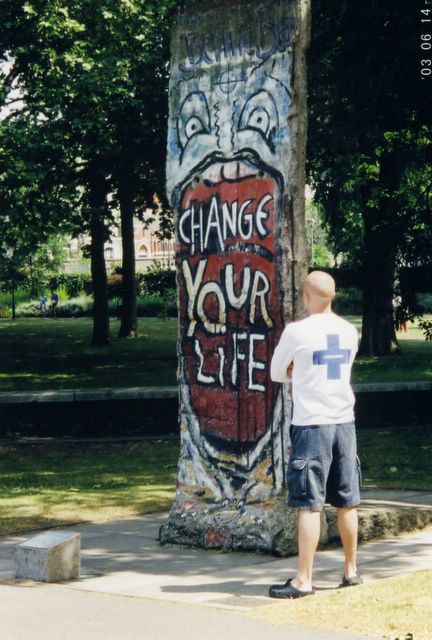
It seemed that she had traveled to Europe one summer with a school trip. She got to know Clark well and took the above photograph while traveling over there.
All three of us knew Clark and all three of us knew depression. We vented about all our frustrations and then came the million dollar question I began with.
Is that too harsh? Too over-dramatic? Some could not even conceive of an institute that trains the next generation of Christian leaders as being responsible for the suicide of one of it's trainees. Yet some would cast the blame no where else.
We dialogued about frustrations over the loss of Clark, the culture of evangelicalism and our alma mater. It was an odd sort of therapy session that lasted for almost two hours. Even as the sun disappeared behind some buildings and the breeze brought back the all too familiar chill, we kept talking and chomping down on the guacamole and chips we ordered. All the other customers had retreated into the restaurant to warm up.
The chill outside reminded us that it was not yet the longed-for summer. We were inbetween seasons, having lived through the sunless winter and rainy spring but still waiting for the deliverance of summer. We were in an inbetween period where we had to persevere for the better that was to come.
My friend only lived about a block from the restaurant and invited us over to see her place. She mentioned earlier that a friend had given her an expensive bottle of tequila as a gift and that she didn't want to just open it to drink it alone. This seemed like a worthy occasion so she opened it.
"So what are we going to drink to?" she asked. "You're supposed to drink to something."
"How 'bout surviving?" I said.
"That sounds good," said my other friend.
"To surviving evangelicalism," she said.
We raised our shot glasses with a clink and let the warmth of the liquor remind of the coming summer.
A friend of mine posed this question not too long ago while she and another friend of mine joined me at an outdoor patio of a restaurant.
It was the first sunny day that dried up the April showers and began to usher in the May flowers. The breeze bustled through the patio and made me wonder how heavy the margarita glasses on our table were. They were holding their own so they must be heavy enough.
Each of us were halfway through our tequila and lime drinks when my friend (whom I hadn't talked with in over a year) asked, "Did you know Clark Stacy?" (See $%&*& $*#!)
It seemed that she had traveled to Europe one summer with a school trip. She got to know Clark well and took the above photograph while traveling over there.
All three of us knew Clark and all three of us knew depression. We vented about all our frustrations and then came the million dollar question I began with.
Is that too harsh? Too over-dramatic? Some could not even conceive of an institute that trains the next generation of Christian leaders as being responsible for the suicide of one of it's trainees. Yet some would cast the blame no where else.
We dialogued about frustrations over the loss of Clark, the culture of evangelicalism and our alma mater. It was an odd sort of therapy session that lasted for almost two hours. Even as the sun disappeared behind some buildings and the breeze brought back the all too familiar chill, we kept talking and chomping down on the guacamole and chips we ordered. All the other customers had retreated into the restaurant to warm up.
The chill outside reminded us that it was not yet the longed-for summer. We were inbetween seasons, having lived through the sunless winter and rainy spring but still waiting for the deliverance of summer. We were in an inbetween period where we had to persevere for the better that was to come.
My friend only lived about a block from the restaurant and invited us over to see her place. She mentioned earlier that a friend had given her an expensive bottle of tequila as a gift and that she didn't want to just open it to drink it alone. This seemed like a worthy occasion so she opened it.
"So what are we going to drink to?" she asked. "You're supposed to drink to something."
"How 'bout surviving?" I said.
"That sounds good," said my other friend.
"To surviving evangelicalism," she said.
We raised our shot glasses with a clink and let the warmth of the liquor remind of the coming summer.
Tuesday, May 24, 2005
Black, White and Red (Sometimes) All Over
During my many hours of TV watching last week, I came a across a show that I swore would have been directed by Quentin Tarantino (Kill Bill Vol.s, Pulp Fiction and the like). And sure enough, as I read in the entertainment section of the newspaper, it was.
What gave it away were scenes ripe with pop culture references, an imaginative presentation of gore (the show was CSI) and his trademark new style: using black and white film in particularly violent scenes.
The two-hour season finale of CSI saw one of the main characters getting buried alive in a glass coffin, much like Uma Thurman in the second Kill Bill. The rest of the team spent the remaining time trying to find him and dig him out without setting off the explosive charges rigged to the coffin. This is trademark Tarantino 'creativity.'
During the show, the man who buried the c.s.i. blew himself up in an attempt to take out other c.s.i. When the explosion was shown, the film switched to black and white to show the results. The film switched back to color to show that another c.s.i. had survived the blast.
Still later in the show, the man buried alive had either a dream or hallucination that an autopsy was being performed on him while he was conscious. When the blood began to flow and the organs were passed around, the film was in black and white again. After it was over, the man dreaming was shown from the neck up in color, slighty bloody (althouth not flowing). To end the scene, the doctors jokingly picked up the man's heart and told the subject's father, "He had a good heart." You gotta love that creativity and wit.
Tarantino used the same method in the Kill Bill Vol. 1 in order to not disturb a 10-15 minute scene where Uma Thurman slaughters an 88-man Japanese hit squad in some pretty disturbing ways. The color instantly disappeared when Thurman took out an eye of one of the men, making it an interesting style and transition to black and white. It returned to normal when Thurman blinked her eyes in a facial close-up after most of the team lay throughout the scene in varying degrees of slaughter.
Tarantino and Robert Roderiguez used similar techinques in Sin City (See Love, BaSin City Style). Most of the movie was already in black and white to begin with but when even the brutality was too much for black and white, the film took another step. Black and white cut-outs of characters were used to portray what happened, almost like flannelgraph figures on a felt board. This was used to show Elijah Wood's character get eaten by a dog.
Somehow, the color swap makes the violence not as visceral or real. And that's why the MPAA says okay to an R-rating for the above mentioned films. Kudos to Tarantino on the creative use of style to make us almost enjoy watching violence.
But woe to us if we are enticed to sit through this style in a movie which lacks any redeeming qualities.
What gave it away were scenes ripe with pop culture references, an imaginative presentation of gore (the show was CSI) and his trademark new style: using black and white film in particularly violent scenes.
The two-hour season finale of CSI saw one of the main characters getting buried alive in a glass coffin, much like Uma Thurman in the second Kill Bill. The rest of the team spent the remaining time trying to find him and dig him out without setting off the explosive charges rigged to the coffin. This is trademark Tarantino 'creativity.'
During the show, the man who buried the c.s.i. blew himself up in an attempt to take out other c.s.i. When the explosion was shown, the film switched to black and white to show the results. The film switched back to color to show that another c.s.i. had survived the blast.
Still later in the show, the man buried alive had either a dream or hallucination that an autopsy was being performed on him while he was conscious. When the blood began to flow and the organs were passed around, the film was in black and white again. After it was over, the man dreaming was shown from the neck up in color, slighty bloody (althouth not flowing). To end the scene, the doctors jokingly picked up the man's heart and told the subject's father, "He had a good heart." You gotta love that creativity and wit.
Tarantino used the same method in the Kill Bill Vol. 1 in order to not disturb a 10-15 minute scene where Uma Thurman slaughters an 88-man Japanese hit squad in some pretty disturbing ways. The color instantly disappeared when Thurman took out an eye of one of the men, making it an interesting style and transition to black and white. It returned to normal when Thurman blinked her eyes in a facial close-up after most of the team lay throughout the scene in varying degrees of slaughter.
Tarantino and Robert Roderiguez used similar techinques in Sin City (See Love, BaSin City Style). Most of the movie was already in black and white to begin with but when even the brutality was too much for black and white, the film took another step. Black and white cut-outs of characters were used to portray what happened, almost like flannelgraph figures on a felt board. This was used to show Elijah Wood's character get eaten by a dog.
Somehow, the color swap makes the violence not as visceral or real. And that's why the MPAA says okay to an R-rating for the above mentioned films. Kudos to Tarantino on the creative use of style to make us almost enjoy watching violence.
But woe to us if we are enticed to sit through this style in a movie which lacks any redeeming qualities.
Wednesday, May 11, 2005
Palahniuk Inspires
“Maybe people have to suffer before they can risk doing what they love.”
You told Misty all this.
You said how Michelangelo was a manic-depressive who portrayed himself as a flayed martyr in his painting. Henri Matisse gave up being a lawyer because of appendicitis. Robert Shumann only began composing after his right hand became paralyzed and ended his career as a concert pianist.
…
You talked about Nietzsche and his tertiary syphilis. Mozart and his uremia. Paul Klee and the scleroderma that shrank his joints and muscles to death. Frida Kahlo and the spine bifida that covered her legs with bleeding sores. Lord Byron and his clubfoot. The Bronte sisters and their tuberculosis. Mark Rothko and his suicide. Flannery O’Connor and her lupus. Inspiration needs disease, injury, madness.
“According to Thomas Mann,” Peter said, “‘Great artists are great invalids.’”
The above is an excerpt from Diary, a novel by Chuck Palahniuk, who also wrote Fight Club. So far (78 pages into it) I’m hooked and (despite the cliché-ness of it) inspired by it. The above talk about artists and the writing style of the book itself is inspiring.
The nihilistic tone made famous by the rants of Tyler Durden is the basis for the book; yet in the blunt, crassness of the writing all that is faux is stripped away, leaving raw nerves, harsh realities. But those nerves and realities are what lead to authentic change.
In the book, an artist named Misty married young in art school and was swept away to some idyllic small town on an idyllic island home where she could paint pictures that would change people’s lives. But the island was spoiled by tourists, advertisements and commercialism, and her husband, Peter, shot himself in the family car.
While the husband sits in a hospital hooked up to life support, Misty gets calls from summer home owners in the idyllic towns near the island where Peter had done some remodeling during the winter. Everyone complains of kitchens or linen closets missing from their homes, leading Misty to find that Peter sealed in entire rooms from the house.
Inside the rooms are nonsensical, yet prophetic scrawlings covering the sealed-in rooms. Some of it is nonsense while others are crass descriptions of life on the island. Intermingled with the nonsense are random quotes from various artists that somehow apply to life on the island or Misty.
I don’t know what happens from then on as Misty tries to figure out what all that means but I know that Palahniuk is an engaging storyteller. And the artistic dialogue is spurring me on to produce something.
You told Misty all this.
You said how Michelangelo was a manic-depressive who portrayed himself as a flayed martyr in his painting. Henri Matisse gave up being a lawyer because of appendicitis. Robert Shumann only began composing after his right hand became paralyzed and ended his career as a concert pianist.
…
You talked about Nietzsche and his tertiary syphilis. Mozart and his uremia. Paul Klee and the scleroderma that shrank his joints and muscles to death. Frida Kahlo and the spine bifida that covered her legs with bleeding sores. Lord Byron and his clubfoot. The Bronte sisters and their tuberculosis. Mark Rothko and his suicide. Flannery O’Connor and her lupus. Inspiration needs disease, injury, madness.
“According to Thomas Mann,” Peter said, “‘Great artists are great invalids.’”
The above is an excerpt from Diary, a novel by Chuck Palahniuk, who also wrote Fight Club. So far (78 pages into it) I’m hooked and (despite the cliché-ness of it) inspired by it. The above talk about artists and the writing style of the book itself is inspiring.
The nihilistic tone made famous by the rants of Tyler Durden is the basis for the book; yet in the blunt, crassness of the writing all that is faux is stripped away, leaving raw nerves, harsh realities. But those nerves and realities are what lead to authentic change.
In the book, an artist named Misty married young in art school and was swept away to some idyllic small town on an idyllic island home where she could paint pictures that would change people’s lives. But the island was spoiled by tourists, advertisements and commercialism, and her husband, Peter, shot himself in the family car.
While the husband sits in a hospital hooked up to life support, Misty gets calls from summer home owners in the idyllic towns near the island where Peter had done some remodeling during the winter. Everyone complains of kitchens or linen closets missing from their homes, leading Misty to find that Peter sealed in entire rooms from the house.
Inside the rooms are nonsensical, yet prophetic scrawlings covering the sealed-in rooms. Some of it is nonsense while others are crass descriptions of life on the island. Intermingled with the nonsense are random quotes from various artists that somehow apply to life on the island or Misty.
I don’t know what happens from then on as Misty tries to figure out what all that means but I know that Palahniuk is an engaging storyteller. And the artistic dialogue is spurring me on to produce something.
From Homicide to Espresso
Change is good. Especially when you're able to change the types of conversations you have during the normal course of the day.
I used to have to ask, "Well, how many times was the man shot and where? Were there any shell casings at the scene? Was the shooting gang-related? Are you currently questioning the mother in connection to the shooting?"
But now I'll have to ask, "Would you like that frappacino affogato style? Would you like to try our new Chantico drinking chocolate? How's it going, do you want your normal double-shot soy latte? You're asking me if refills are free?"
I have succumbed to working for the man, the Big Brother of coffee, the corporate, suburbanized chain store I have always tried to avoid if possible. But to avoid advertising for them, I shall call them the coffee-chain-that-shall-remain-nameless.
Call me a sell-out but the benefits, flexibility and quality tips seemed a good offer at the coffee-chain-that-shall-remain. This would be career suicide if I were to pursue journalism but since I'm not, the coffee-chain-that-shall will work fine.
It's kind of a career twist but who doesn't need a change now and then to refocus their lives, reevaluate career choices and rediscover what a person's passions are. And the coffee-chain-that-shall seems to be an ideal place for that.
And if you know me, that means that sometime in the near future, you'll be getting a pound of beans from the the coffee-chain-that.
I used to have to ask, "Well, how many times was the man shot and where? Were there any shell casings at the scene? Was the shooting gang-related? Are you currently questioning the mother in connection to the shooting?"
But now I'll have to ask, "Would you like that frappacino affogato style? Would you like to try our new Chantico drinking chocolate? How's it going, do you want your normal double-shot soy latte? You're asking me if refills are free?"
I have succumbed to working for the man, the Big Brother of coffee, the corporate, suburbanized chain store I have always tried to avoid if possible. But to avoid advertising for them, I shall call them the coffee-chain-that-shall-remain-nameless.
Call me a sell-out but the benefits, flexibility and quality tips seemed a good offer at the coffee-chain-that-shall-remain. This would be career suicide if I were to pursue journalism but since I'm not, the coffee-chain-that-shall will work fine.
It's kind of a career twist but who doesn't need a change now and then to refocus their lives, reevaluate career choices and rediscover what a person's passions are. And the coffee-chain-that-shall seems to be an ideal place for that.
And if you know me, that means that sometime in the near future, you'll be getting a pound of beans from the the coffee-chain-that.
Monday, April 18, 2005
Fun At The Library
I visited my local public library today and found out just how comfortable some people are looking at porn.
I was in a computer room, when I happened to look behind me and saw a man on the opposite wall, looking at all kinds of porn. There were about seven other people in the room, including teenage girls.
Now each computer had a screen draped in front of the monitor that made viewing from anywhere but directly in front of it difficult. So people couldn't directly see what he was looking at except if they were in front of the monitor, or across the room and directly behind it, as I was.
A librarian even came into the room to help someone beside the man print something. Before this, the young girl beside the man asked him if he knew how to print something from the computer. He calmly told her how and went back to his voyeristic viewing in the middle of the afternoon in the library.
I never thought someone would be bold enough or desperate enough to have to go to a library to look at porn. But, then again, maybe I overestimated everyone's carnal nature.
Too bad libraries have become battle grounds for freedom of expression and ways for the ACLU to fight for the ability to look at pornography next to teenage girls.
I was in a computer room, when I happened to look behind me and saw a man on the opposite wall, looking at all kinds of porn. There were about seven other people in the room, including teenage girls.
Now each computer had a screen draped in front of the monitor that made viewing from anywhere but directly in front of it difficult. So people couldn't directly see what he was looking at except if they were in front of the monitor, or across the room and directly behind it, as I was.
A librarian even came into the room to help someone beside the man print something. Before this, the young girl beside the man asked him if he knew how to print something from the computer. He calmly told her how and went back to his voyeristic viewing in the middle of the afternoon in the library.
I never thought someone would be bold enough or desperate enough to have to go to a library to look at porn. But, then again, maybe I overestimated everyone's carnal nature.
Too bad libraries have become battle grounds for freedom of expression and ways for the ACLU to fight for the ability to look at pornography next to teenage girls.
Monday, April 11, 2005
Love, BaSin City Style
After slightly recovering for a few days after viewing the life and times of criminals and prostitutes from Basin City at my local movie theater, I can almost find some redeemable quality to it(besides the style and panache of director Robert Roderiguez).
One story line has a guy named Marv (Mickey Rourke with lots of prostheses) somehow being redeemed by a night with a lady of the night named Goldie. While they're both sleeping, a cannibalistic Frodo kills Goldie mysteriously, leaving Marv to deal with cops who think he killed her.
So anyway, Marv evades the cops and then tracks the spectacled Elijah Wood down by questioning other people and killing them in grand, bloody, Flannery O'Conner-like ways. He then finds Kevin (Elijah Wood) and lets the culprit experience a different form of cannibalism to complete the cycle of revenge.
So somewhere in there is something redeemable? Sort of. Marv seemed to have felt redeemed by that night with Goldie. His criminal past and violence were assuaged and his soul was somehow redeemed, or so he tells the audience. He valued that love so much he was willing to kill again and again and again. And then again and again and yet again.
So love is the highest cause or worth fighting for? Or love is what can redeem us? I don't know. That little bit seemed to be something to help me justify seeing one of the nastiest movies yet to date.
One story line has a guy named Marv (Mickey Rourke with lots of prostheses) somehow being redeemed by a night with a lady of the night named Goldie. While they're both sleeping, a cannibalistic Frodo kills Goldie mysteriously, leaving Marv to deal with cops who think he killed her.
So anyway, Marv evades the cops and then tracks the spectacled Elijah Wood down by questioning other people and killing them in grand, bloody, Flannery O'Conner-like ways. He then finds Kevin (Elijah Wood) and lets the culprit experience a different form of cannibalism to complete the cycle of revenge.
So somewhere in there is something redeemable? Sort of. Marv seemed to have felt redeemed by that night with Goldie. His criminal past and violence were assuaged and his soul was somehow redeemed, or so he tells the audience. He valued that love so much he was willing to kill again and again and again. And then again and again and yet again.
So love is the highest cause or worth fighting for? Or love is what can redeem us? I don't know. That little bit seemed to be something to help me justify seeing one of the nastiest movies yet to date.
Wednesday, March 30, 2005

Thursday, March 24, 2005
F%*&!#@ $#^&!
That's what has gone through my mind over the last six days. That's what sums up my emotions since I heard that Clark Stacy committed suicide on March 18, 2005.
I don't know how to describe the anger I feel over his death. I'm enraged another person has fallen to depression and accepted that stopping one's heart is easier to deal with than whatever lot God has given to them.
I'm so pissed and sad at the same time. Could this be a righteous anger? Righteous anger at myself for not probing him more when I had worked out with him at the gym? Righteous anger for not being a better friend or an R.A.? Righteous anger at knowing exactly what depression looks and feels like and not recognizing it earlier in Clark? Righteous anger at the community in which he lived in for being intolerant or ignorant of his true problems and for doing nothing? Righteous anger at being part of that community?
Probably all of the above but also none of the above. Answers in a time like this are harder to find than the guilty snowflake that initiated the avalanche. Answers always come slow (if at all) with tragedy or with understanding the multi-faceted disease of depression.
So many factors are involved in depression and suicide that they can only be understood after extended periods of doubting God and yourself; periods of knowing who God is and knowing who you are. There isn't any trick or guidebook on how or how not to be depressed. God created us all too creatively and with too much ingenuity to have some magic formula that would cure all people everywhere. If there was a god that simple, who would care enough to be in wonder of him or worship him?
An aspect of depression I've known is how alone you can feel. Yes, there's that community of believers, that congregation representing the body of Christ, that fellowship that exists anywhere two or more are gathered in his name. But those can all cease to exist when a person is depressed.
A scary fact to realize is that in the middle of all those things, a depressed person can want to have no part of any of that. Congregations or fellow believers are usually avoided because a depressed person has probably heard too many spiritual clichés from people who don't understand depression. The sick person might rather want to burn down a church around themselves rather than look for the God who is supposed to exist inside it.
And is that what happened to Clark? No one will know because, as some of his closest friends have said, he didn't show any signs of anything being wrong. Some depressed people can win Oscars for their portrayals of a person who has it together because they wouldn't just tell that person on the phone that they're planning to take their own life. It's just not your typical dinner conversation.
I don't know what kind of answers to give right now. I've cried and am sure I will cry, grieve, yell and say more things worthy to be replaced by asterisks, ampersands and exclamation points in the near future. I know that depression is a powerful beast that cannot be ignored. It can drive man to a violent death rather than listen to someone genuinely wanting to help. It can numb the most exuberant disciple into a fetal position, longing to catch a glimpse of the God he used to know.
I know that sometimes, God, in his usual omnipotent and omniscient way, will become real again and seem to be sitting right behind me. He will be more visible through relationships and fellowship and will wash over me in the honest words I exchange with friend. And until that time, I guess we'll see what my faith is for.
I don't know how to describe the anger I feel over his death. I'm enraged another person has fallen to depression and accepted that stopping one's heart is easier to deal with than whatever lot God has given to them.
I'm so pissed and sad at the same time. Could this be a righteous anger? Righteous anger at myself for not probing him more when I had worked out with him at the gym? Righteous anger for not being a better friend or an R.A.? Righteous anger at knowing exactly what depression looks and feels like and not recognizing it earlier in Clark? Righteous anger at the community in which he lived in for being intolerant or ignorant of his true problems and for doing nothing? Righteous anger at being part of that community?
Probably all of the above but also none of the above. Answers in a time like this are harder to find than the guilty snowflake that initiated the avalanche. Answers always come slow (if at all) with tragedy or with understanding the multi-faceted disease of depression.
So many factors are involved in depression and suicide that they can only be understood after extended periods of doubting God and yourself; periods of knowing who God is and knowing who you are. There isn't any trick or guidebook on how or how not to be depressed. God created us all too creatively and with too much ingenuity to have some magic formula that would cure all people everywhere. If there was a god that simple, who would care enough to be in wonder of him or worship him?
An aspect of depression I've known is how alone you can feel. Yes, there's that community of believers, that congregation representing the body of Christ, that fellowship that exists anywhere two or more are gathered in his name. But those can all cease to exist when a person is depressed.
A scary fact to realize is that in the middle of all those things, a depressed person can want to have no part of any of that. Congregations or fellow believers are usually avoided because a depressed person has probably heard too many spiritual clichés from people who don't understand depression. The sick person might rather want to burn down a church around themselves rather than look for the God who is supposed to exist inside it.
And is that what happened to Clark? No one will know because, as some of his closest friends have said, he didn't show any signs of anything being wrong. Some depressed people can win Oscars for their portrayals of a person who has it together because they wouldn't just tell that person on the phone that they're planning to take their own life. It's just not your typical dinner conversation.
I don't know what kind of answers to give right now. I've cried and am sure I will cry, grieve, yell and say more things worthy to be replaced by asterisks, ampersands and exclamation points in the near future. I know that depression is a powerful beast that cannot be ignored. It can drive man to a violent death rather than listen to someone genuinely wanting to help. It can numb the most exuberant disciple into a fetal position, longing to catch a glimpse of the God he used to know.
I know that sometimes, God, in his usual omnipotent and omniscient way, will become real again and seem to be sitting right behind me. He will be more visible through relationships and fellowship and will wash over me in the honest words I exchange with friend. And until that time, I guess we'll see what my faith is for.
Wednesday, March 16, 2005
A Familiar Need
My day is brightened many shades when I can hear the 90s hour on local rock-stations. And luckily in Chicago, this comes twice a day, at 9 a.m. and at noon, thanks to the alliteration.
My mind is soothed to hear Chris Cornell scream through "Spoonman" or Scott Weiland wail through "Wicked Garden." These are songs I lived and matured by in high school and will always consider familiar. They represent a time in my life that I know intimately; a time that I look back on and instantly grow happy.
The happiness doesn't come from a lovely experience from that time of life (junior high and high school aren't times that I'd like to relive) but more just from being reminded of something I am familiar with.
That familiarity brings security. I know every guitar riff and bridge of "Cumbersome" by Seven Mary Three from repeated listenings. I know exactly what will come after the chorus, "I have become cumbersome to this world" and I can rest easy because of that. This is something I know. This is something I can follow and not get lost. I get exuberant knowing that the next line is "And my girl."
You wouldn't think that a successful college graduate would need such trivialities as decade-old songs to bring them peace in their lives. But I do. You'd think that a person could find this kind of familiarity and peace in a relationship with the Almighty, a significant other or congregation of believers. But sometimes some people can't.
And because of this, the Red Hot Chili Peppers' cover of "Love Rollercoaster" manifests a safe haven where a person can relax, because the listener knows what comes next. The listener knows the future, at least for another 1 minute and 36 seconds.
I know this kind of peace is utterly insufficient to meet any kind of real need but it does remind me of the peace and comfort I need to find in Christ. I know that no number of playings of any of 90s songs can bring any lasting peace, only the kind that make me yearn for the true kind that comes through the Spirit.
My mind is soothed to hear Chris Cornell scream through "Spoonman" or Scott Weiland wail through "Wicked Garden." These are songs I lived and matured by in high school and will always consider familiar. They represent a time in my life that I know intimately; a time that I look back on and instantly grow happy.
The happiness doesn't come from a lovely experience from that time of life (junior high and high school aren't times that I'd like to relive) but more just from being reminded of something I am familiar with.
That familiarity brings security. I know every guitar riff and bridge of "Cumbersome" by Seven Mary Three from repeated listenings. I know exactly what will come after the chorus, "I have become cumbersome to this world" and I can rest easy because of that. This is something I know. This is something I can follow and not get lost. I get exuberant knowing that the next line is "And my girl."
You wouldn't think that a successful college graduate would need such trivialities as decade-old songs to bring them peace in their lives. But I do. You'd think that a person could find this kind of familiarity and peace in a relationship with the Almighty, a significant other or congregation of believers. But sometimes some people can't.
And because of this, the Red Hot Chili Peppers' cover of "Love Rollercoaster" manifests a safe haven where a person can relax, because the listener knows what comes next. The listener knows the future, at least for another 1 minute and 36 seconds.
I know this kind of peace is utterly insufficient to meet any kind of real need but it does remind me of the peace and comfort I need to find in Christ. I know that no number of playings of any of 90s songs can bring any lasting peace, only the kind that make me yearn for the true kind that comes through the Spirit.
Tuesday, March 08, 2005
Crouching What?!
There are many hours of the day where I have to listen to a police scanner and hear cops relay incidents that happen in the city.
There's always calls of "shots fired" or of a 10-1, which is a cop calling for backup. Some of the dispatchers who talk to the police and relay the messages can be enjoyable to listen to, as some receive ridiculous notifications. "Mrs. Adams called and said that some youngsters were outside playing loud music and misbehaving."
But the other night, a dispatcher relayed a call of "Crouching tiger, hidden prostitute."
Crouching what?
Yes. Apparently, someone called from a cell phone to say that a lady of ill repute was crouching behind some bushes and the caller wanted to report it to police.
Hearing that got my hopes up of hearing other possible calls. A gang disturbance in one of the larger hispanic neighborhoods (La Vallita) called in as: "Big Trouble in Little Village." A person stranded on a boat in Lake Michigan: "Seabiscuit." And so on and so forth.
There's always calls of "shots fired" or of a 10-1, which is a cop calling for backup. Some of the dispatchers who talk to the police and relay the messages can be enjoyable to listen to, as some receive ridiculous notifications. "Mrs. Adams called and said that some youngsters were outside playing loud music and misbehaving."
But the other night, a dispatcher relayed a call of "Crouching tiger, hidden prostitute."
Crouching what?
Yes. Apparently, someone called from a cell phone to say that a lady of ill repute was crouching behind some bushes and the caller wanted to report it to police.
Hearing that got my hopes up of hearing other possible calls. A gang disturbance in one of the larger hispanic neighborhoods (La Vallita) called in as: "Big Trouble in Little Village." A person stranded on a boat in Lake Michigan: "Seabiscuit." And so on and so forth.
Tuesday, February 22, 2005
Grow Up
It seems that growing up means realizing more who you are and knowing your own faults and habits and then working to function well in spite of them.
For me, I've come to realize that I'm lazy and will always settle for whatever is "good enough." Conversations with my mom help me to see that it runs in the family. Conversations with friends help me to see how much potential I have. And conversations with those closest to me help me to see how much it affects others.
So in order for some college graduate to be able to move on into the next stage of life, be it adulthood, a better-paying job or more fulfilling relationships, then it seems I have to stop being so lazy.
I could put my talent to use (besides just blathering on in some blog) and write novels, screenplays, free-lance articles that could land me better jobs and help me grow up a little. I could write that stereotypical Great American Novel and get published at the young age of 20-something, insuring cash-flow and a much-coveted income so I could continue to write passionate books that tackle life as we know it today.
But then I'm sure I would get lazy again, since I could roll out of bed any time I felt like it. Have my private Italitan chef Gianluca whip up a greek omlete that melts in your mouth. Try to find something to watch for a half-hour on my satellite television (even though it takes at least 45 minutes just to get through all the channels or watch the preview channel).
I'd lounge around in my papasan chair with a White Russian in one hand and an electronic solitare game in the other until I fell asleep. That would be soooo lazy.
So maybe I won't write that passionate, enthralling novel and condemn myself to a life of excess and laziness.
Maybe I'll just keep writing a blog and use my time better. Maybe I'll not watch so much T.V. Maybe I'll read a little more for fun and write a little more fun. Maybe I'll be a more proactive in my friendships and in finding a better job. That will be more than "good enough," I'm sure.
For me, I've come to realize that I'm lazy and will always settle for whatever is "good enough." Conversations with my mom help me to see that it runs in the family. Conversations with friends help me to see how much potential I have. And conversations with those closest to me help me to see how much it affects others.
So in order for some college graduate to be able to move on into the next stage of life, be it adulthood, a better-paying job or more fulfilling relationships, then it seems I have to stop being so lazy.
I could put my talent to use (besides just blathering on in some blog) and write novels, screenplays, free-lance articles that could land me better jobs and help me grow up a little. I could write that stereotypical Great American Novel and get published at the young age of 20-something, insuring cash-flow and a much-coveted income so I could continue to write passionate books that tackle life as we know it today.
But then I'm sure I would get lazy again, since I could roll out of bed any time I felt like it. Have my private Italitan chef Gianluca whip up a greek omlete that melts in your mouth. Try to find something to watch for a half-hour on my satellite television (even though it takes at least 45 minutes just to get through all the channels or watch the preview channel).
I'd lounge around in my papasan chair with a White Russian in one hand and an electronic solitare game in the other until I fell asleep. That would be soooo lazy.
So maybe I won't write that passionate, enthralling novel and condemn myself to a life of excess and laziness.
Maybe I'll just keep writing a blog and use my time better. Maybe I'll not watch so much T.V. Maybe I'll read a little more for fun and write a little more fun. Maybe I'll be a more proactive in my friendships and in finding a better job. That will be more than "good enough," I'm sure.
Subscribe to:
Posts (Atom)